


Headlines about "millions in damages" due to congestion tell only half the story. If you zoom in on the daily reality of the freight forwarder, you see that the pain of 2025 lies not just in delayed ships, but in a logistics framework that has backed itself into a corner with no clear way out.
Internal data and conversations with Shypple’s operational experts reveal that the damage of 2025 manifests primarily in a forced shift to road transport, exploding waiting costs, and a market that, despite everything, is not yet ready to truly change.
1. The illusion of choice: a 70% shift to trucking
For years, the motto was: "Get containers off the road, use inland shipping (barge)." In 2025, that trend reversed completely. "The problem has simply been displaced," states an Operations Lead at Shypple.
"Because inland shipping became too unpredictable due to congestion, we saw 70% of volumes shift to trucks this year. Customers are cutting their losses and opting for certainty."
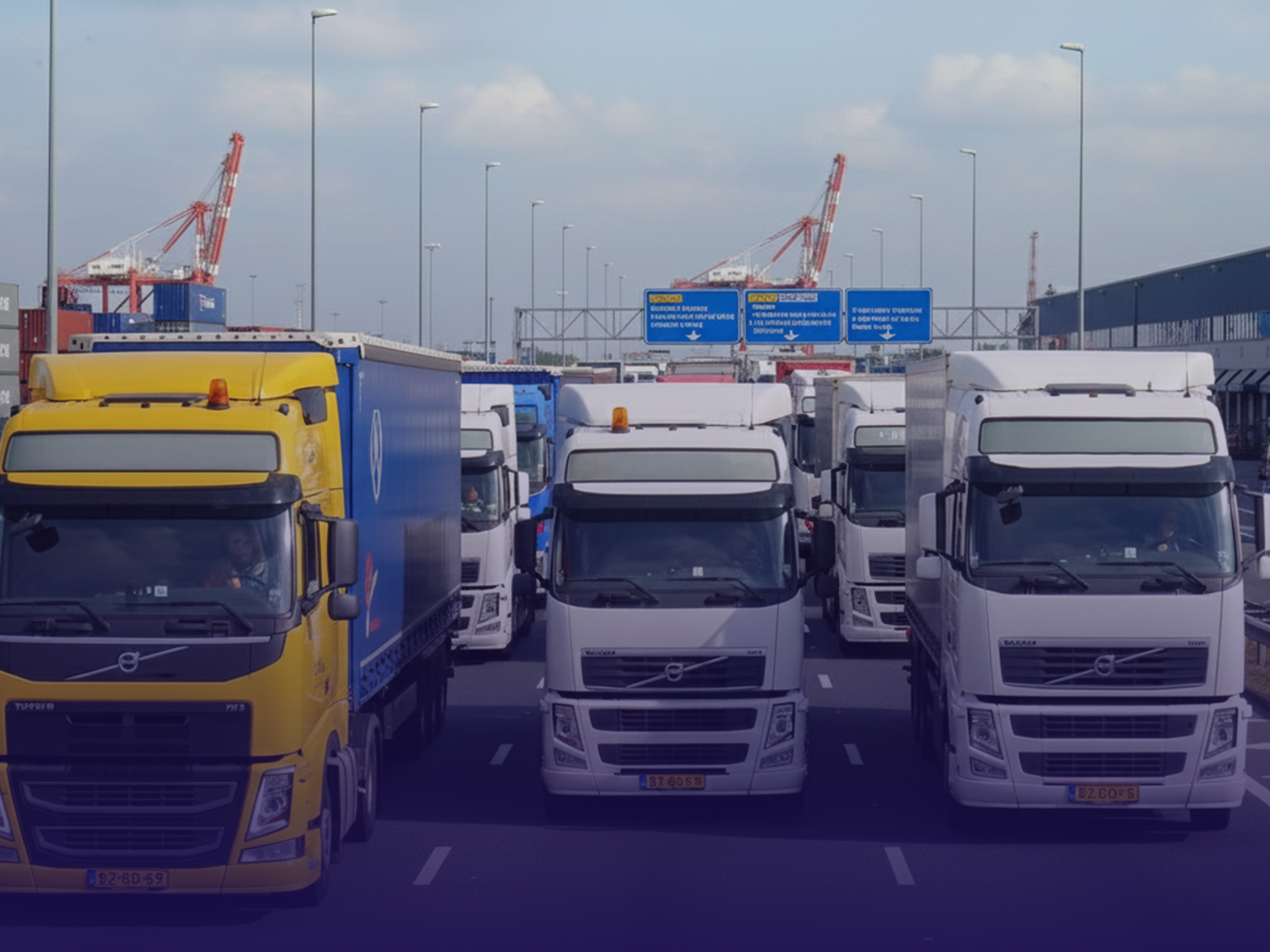
But that choice comes at a price, literally and operationally. This move to road transport eventually caused 4-kilometer queues of trucks at the terminal. "Drivers often face waits of 6 to 7 hours on a busy day," according to Shypple’s data. "This puts their driving time regulations at risk, meaning the cargo arrives late anyway. You pay for speed (via truck), but you get a standstill."
2. The painful calculation: waiting costs as silent profit killers
While demurrage and detention are the most obvious costs, but in practice, the importer struggled primarily with waiting costs throughout 2025. Several examples illustrate this impact:
- On a shipment with a transport tariff of €368, an additional €207 in waiting costs was added (+56.3%).
- Another example on the same type of booking saw an extra €120 (32.6%) added in waiting fees.
"Suddenly, a trip becomes tens of percentages more expensive, which causes friction. We are standing in that traffic jam too. These costs are not profit for us; they are pure damage to the entire supply chain. Delivering that message is a daily balancing act."
3. 'Peak season' surcharges: a solution or adding insult to injury?
What also defined 2025 was a sense of powerlessness. Terminals and carriers introduced Peak Season Surcharges to regulate the crowds. Did it work?
"No," from those on the ground at Shypple. "Those surcharges feel like rubbing salt in the wound.It doesn’t solve the traffic jam; it only makes the jam more expensive. No concrete solutions were offered, only higher invoices."
Remarkably, the pressure isn't strong enough yet to move the market towards a new approach. "Night distribution is failing to gain traction. It’s either joining the queue during the day or driving at night for a higher rate. Companies still choose the traffic jam. Transport is evidently, despite the increases, still too cheap to force that efficiency shift."
4. Outlook 2026: Speed vs. price
Has 2025 been a wake-up call for the importer? Only partially. Shypple sees a split emerging as we head into 2026:
- Fresh goods move ports: "Here, shelf life rules. Despite the costs, we see customers in this sector diverting to Antwerp or Zeebrugge. They cannot afford a single day of standstill."
- General cargo: "Here, price continues to rule. We see very few structural changes to purchasing strategies or inventory levels; most companies appear to be waiting for market conditions to stabilize."
With the ongoing uncertainty surrounding the Suez Canal, that wait-and-see approach may be risky.The lesson of 2025 is that waiting for better times is not a strategy. Companies that fail to adapt their planning through new routes or night slots will simply find themselves at the back of that 4-kilometer queue in 2026.


