This week in brief:
The market from the Far East to Europe is giving mixed signals. On balance, we expect rates to stay flat in November.
Signs of rising rates. Several carriers, including Hapag-Lloyd, Maersk, COSCO and CMA CGM, announced rate increases from 15 November. Carriers also cancel sailings in weeks 45 and 46 (2 to 15 November): Drewry counted eight blank sailings (cancelled departures) on Asia to Europe for the week of 26 October and four for next week, The Loadstar reports. Some CMA CGM services are already overbooked, and some agents expect space and equipment to get tighter later in November.
Signs of softer rates. The Christmas stock has shipped, and there is open space at origin in China. More ships use the Suez Canal again, which adds capacity (more on that below). Spot rates have barely moved. The Drewry World Container Index for Shanghai to Rotterdam rose just 1% in the week to 29 October. Drewry doubts the November increases will hold because demand is weak.
How we read it. Carriers tried the same thing in October. They announced increases, and then rates fell in the second half of the month. We don't expect the increases from 15 November to stick, but we can't rule out a short spike on some services. We will look at the market again in mid-November.
What to do: Book at least 28 days before departure, so we can keep your space with our partners.
The return to the Suez Canal continues. Some services use Suez on the way to Europe but still go around Africa on the way back. Returning services save about a week in transit on average. Carriers expect a full return in early 2027. Each move still depends on security in the Red Sea, and carriers can divert again if it changes.
What this means for you: Ships via Suez and via Africa now arrive at the same time, which causes bunching at the bigger European ports. Arrival dates can move, in both directions.
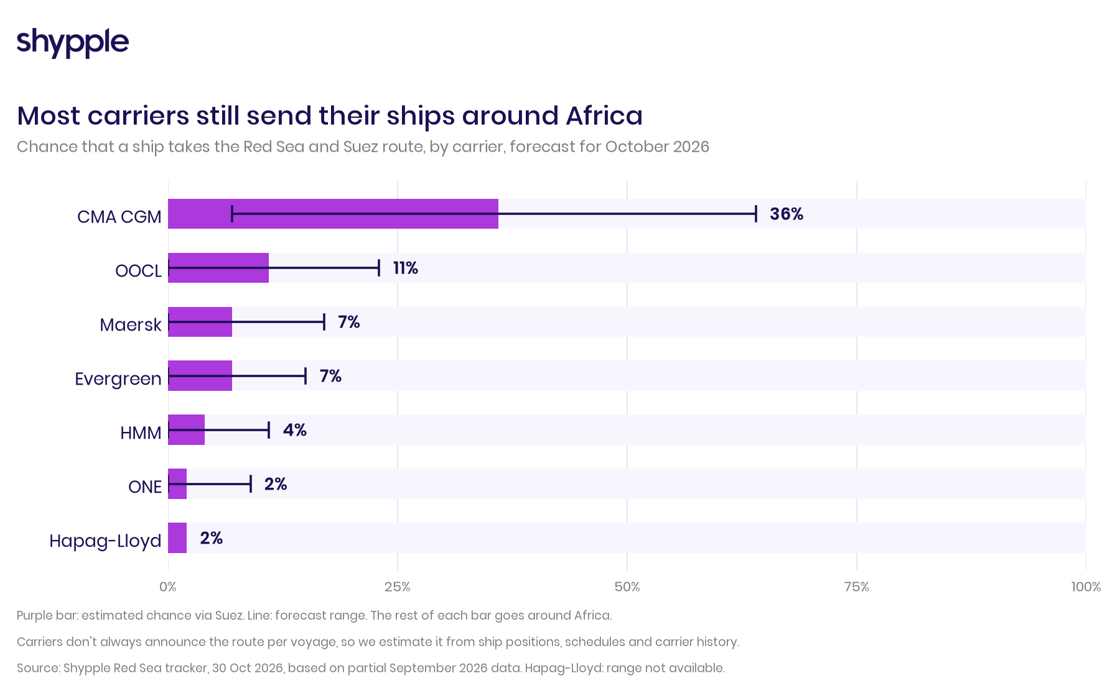
What our own tracker shows. Our Red Sea tracker follows the ships on the Asia to Europe lanes. On 30 October, 2 of them were in the Red Sea or Suez and 31 were on the route around Africa. Nine more were in the Arabian Sea, where ships choose between the two routes. So on the water today, the route around Africa is still the norm. Of the big carriers, CMA CGM sends the most ships via Suez. Maersk, Evergreen, HMM and ONE still send most of theirs around Africa. Even one carrier mixes routes: one Maersk ship is in the Red Sea now, while another rounded the Cape of Good Hope on 20 October.

Carriers don't always announce which route a voyage takes. So our tracker estimates it per ship, from where the ship is now, its planned transit time and the carrier's recent voyages. The chart shows the result per carrier.
What to do: Plan with the transit time around Africa unless we confirm your ship goes via Suez. From South Asia, Suez takes about 30 days or less and the route around Africa 34 days or more. Check the routing and latest arrival date of your booking with us before you plan trucks or promise a delivery date.
Chinese New Year falls on 6 February 2027, 11 days earlier than in 2026. Factories close in stages. Some stop a week before the holiday, and some in southern China stop up to three weeks before. Many only return to full output after the Lantern Festival on 20 February. Carriers also usually cancel sailings around the holiday.
The run-up starts on a network that is already stretched. Four typhoons hit East Asia in seven weeks. Drewry says a network needs about five weeks to recover, and delays could run into the pre-holiday rush, according to The Loadstar.
Expect slight upward pressure on rates in December and January, as shippers move cargo before the holiday. Cargo that has to be in Europe before Chinese New Year should leave China in mid to late December. Around 20 January is the hard cut-off for departures before the holiday.
What to do: Send us your December and January volumes now, so we can secure space. Ask your suppliers for their holiday dates. Work back from your last sailing before the holiday: factory completion, pick-up and port cut-off, plus one to two weeks of buffer.
From 30 December 2026, the EU Deforestation Regulation (EUDR) applies to large and medium-sized companies. Small companies follow on 30 June 2027. It covers coffee, cocoa, soy, palm oil, cattle, wood and rubber, and products made from them, such as chocolate. Whoever places these goods on the EU market must prove they don’t come from land deforested after 31 December 2020. That proof is a due diligence statement, which includes the GPS location of the plots where the goods were grown.
What this means for you: Without that reference number, customs cannot clear the goods. Shipments that arrive at the end of December leave origin in November.
What to do: If you import any of these products, ask your suppliers for the plot location data now, and check with us what your customs declaration needs.
Since 21 October, Rijkswaterstaat (the Dutch national roads and waterways authority) limits the N307 on the Houtribdijk to 15 tonnes total weight. The Houtribdijk is the dike road across the IJsselmeer between Enkhuizen (Noord-Holland) and Lelystad (Flevoland). The bridges near Lelystad show cracks in the steel, and the limit may stay in place for years.
About 1,500 trucks a day used the dike, according to the Dutch transport association TLN. The detour via the Afsluitdijk or Amsterdam takes at least 40 minutes, NH Nieuws reports.
What to do: If you ship from or to the Enkhuizen or Flevoland area, plan extra time for pick-ups and deliveries.
The Rhine's reference gauge at Kaub (the point that sets how deep barges can load) read 45 centimetres on the morning of 30 October, up from 11 centimetres on 19 October, according to Pegelonline (WSV), live gauge data. That is still well below the long-term low-water reference of 77 centimetres. If you move cargo by barge on the Rhine, keep truck or rail options open with us.


