The Dutch government has announced a temporary 22.3% reduction in the Truck Toll from 1 September until 31 December 2026, as a measure to support the road transport sector following increased fuel costs. (vrachtwagenheffing.nl)
As a result, Shypple will temporarily reduce its Truck Toll surcharge from €0.21 to €0.17 per kilometre, effective 1 September 2026.
The reduction is temporary. From 1 January 2027, the government discount will end and the toll will return to its previous level. In addition, the Dutch government has confirmed that the 2027 toll rates will be indexed for inflation. The exact 2027 rates and percentage increase are expected to be announced in October 2026.
We will communicate the adjusted Truck Toll surcharge for 2027 once the final rates have been published.
Persistent congestion at ports worldwide is holding back about 1.7 million TEU of ship capacity, close to the size of Evergreen's entire fleet. Source: The Loadstar.
Schedule reliability is stuck at 60% to 65%, well below the 70% to 80% carriers hit before the pandemic. A late ship now arrives 5 to 5.5 days behind schedule on average, up from 3 to 4 days a few years ago. On top of that, more than 3.7 million containers are piling up at ports worldwide as export demand from Asia stays strong.
Rates reflect the split market. Transpacific rates keep climbing, while rates into Europe are falling faster than the week before.
Carriers are investing in the fix, not just riding it out. Hapag-Lloyd is buying a 25% stake in APM Terminals' Maasvlakte II in Rotterdam, a key hub in its Gemini network with Maersk. The terminal is expanding toward 5.4 million containers of annual handling capacity. Financial terms were not disclosed, and the deal still needs regulatory approval. Source: APM Terminals.
💡What to do: Do not read a falling headline rate as falling cost on every lane. Book on realistic transit times, not the schedule, and share your forecasts with your forwarder so we can plan accordingly.
Maersk will remove its peak season surcharge (PSS, a temporary fee carriers add during busy periods) on Far East Asia to North Europe and the Mediterranean from 1 September 2026. It applies to all equipment types: dry, reefer, high-cube, flat rack, open top and tank. Carrier source: Container News.
What changed since our last update (10 August):
Road fuel surcharges for the Netherlands and Belgium reached 26% last week, and 25% for the coming week based on a diesel price of EUR 2.174 a litre. That is a new high, above the June peak of 23% and the level in our last update. Diesel is up roughly EUR 0.35 a litre since mid-July. Source: Shypple fuel surcharges knowledge base
-1.png)
The Rhine told two different stories in ten days. The Kaub gauge, the river's shallowest bottleneck, fell to 6 centimetres on 14 August, the lowest reading since records began in 1880. As of this morning it stood at 45 centimetres, up 14 centimetres on yesterday. Source: Bloomberg
One good morning is not a recovery. An economist at Commerzbank said before this rise that a real recovery was unlikely before October, since it takes weeks of sustained rain to lift the river. Barge operators still apply low-water surcharges per gauge section, and those stay in place until levels hold for longer. We are checking the current per-carrier amounts and will confirm them once verified.
💡What to do: Budget for higher inland cost into the Netherlands, Belgium and Germany for now.
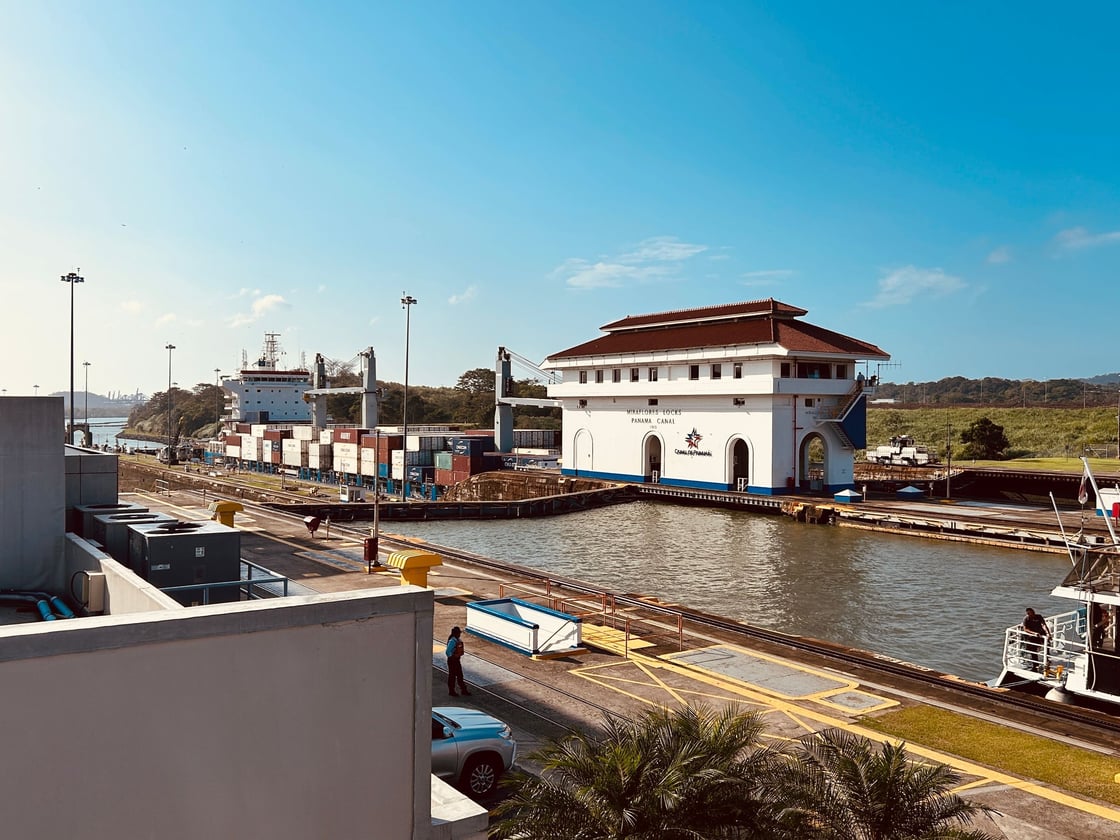
The canal lowers its maximum draft (how deep a ship may sit in the water) twice more: to 14.63 metres (48.0 feet) from 26 August, and to 14.48 metres (47.5 feet) from 3 September. New this week: around 112 vessels are waiting to enter, and eastbound transits face delays of up to 10 days. The cause is low water in Gatun Lake, worsened by a strengthening El Nino and more tankers rerouting through the canal since the Strait of Hormuz became riskier. Sources: The Loadstar.
💡What this means: If you ship via the Panama canal, book earlier, expect less cargo per sailing, and build in a 7 to 10 day buffer for eastbound transits.