This week in brief:
From this week, trucks can only enter the ECT Delta and Euromax terminals on the Maasvlakte (the deep-sea container terminal area of the Port of Rotterdam) with a booked time slot. ECT announced the system on 19 September. It is called the Truck Capacity Management System. On weekdays the slots run for four hours. If your slot is full, the system assigns the next free one, which can be much later.
A truck that arrives too early or misses its slot without cancelling in time can get a €100 surcharge. According to the announcement, ECT starts with an introduction period of one to three months. Surcharges show on invoices during that period but are not collected yet.
The road to the terminals is also still limited. The old Suurhoffbrug on the A15 stays open on the hard shoulder only, and Rijkswaterstaat (the Dutch national roads and waterways authority) has not said how long the repair will take.
💡 What to do: Share documents or instructions as early as you can. Late documents mean a later slot, and a container that sits at the terminal longer risks extra storage or demurrage days. We watch free time against slot availability and flag any container at risk.
If a delay comes from documents that reached us too late, the extra waiting or storage charges fall to the customer, as reported in the message sent last Monday ‘New truck time slot system at ECT Rotterdam (Delta and Euromax), from 5 October 2026’ .
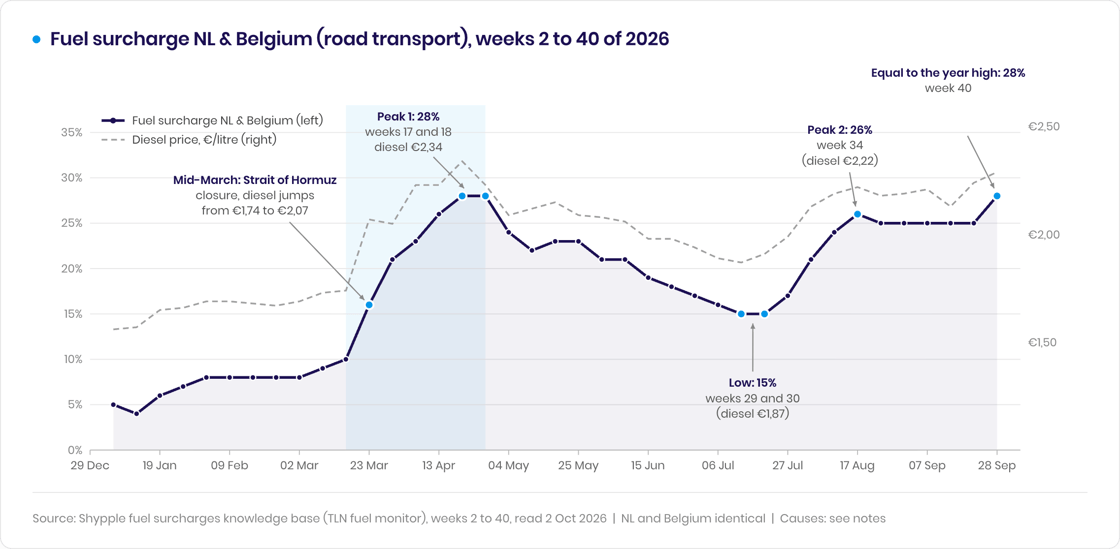
The road fuel surcharge for the Netherlands and Belgium is 28% in week 40 (28 September to 4 October), up from 25%. That equals the highest level of 2026. Diesel averages €2,282 a litre this week. The surcharge follows the weekly diesel price, so the chart shows what moved the price this year:
The latest figures are in our fuel surcharges knowledge base article.
Two ocean surcharges also changed:
China is in Golden Week (the national holiday, 1 to 7 October), so factories are closed. Spot rates from Asia to Europe fell for a second week in a row, according to Drewry (1 October).
The pressure comes when factories reopen and suppliers all want to ship at once. Expect tighter space and firmer rates from around 9 to 14 October. Hapag-Lloyd has announced higher Far East to Europe rates from 19 October.
If you booked at the October rate in the Shypple platform, it stays valid for the whole month. We priced all of October up front, so a rise after Golden Week does not change those bookings. Book early for sailings after 9 October. If a shipment has no hard delivery date, talk to your Shypple contact about timing or another routing.
🎥 Watch how Marc van Haaren explains the expectations for Golden Week below 👇

On 28 September the Panama Canal Authority raised the maximum draft (how deep a loaded ship may sit) to 14.94 metres (49 feet), from 48 feet. Daily transits go from 32 to 33 from 15 October, with a tenth slot for the largest ships. The Authority names the September rainfall and water-saving measures at the locks as the reason. It also warns that the water deficit continues.
This helps shippers on Latin America lanes (Costa Rica, Colombia, Honduras, Guatemala) and the US east coast.
Suez traffic is growing. Linerlytica counted 30 large container ships through the canal last week, the busiest week since 2024, as reported by Seatrade Maritime. CMA CGM now runs its FAL1 and FAL3 services via Suez, and COSCO and OOCL are sending loops back too, mostly in the eastbound direction. Evergreen keeps sailing around the Cape of Good Hope.
So there are services via Suez and via the Cape at the same time. Sailing times do not change soon, because port congestion keeps round trips long.
🎥 Marc van Haaren explains the expectations for when the Suez reopens 👇
The Rhine's reference gauge at Kaub read 0 centimetres on the morning of 2 October. It went below zero on 27 September and reached minus 5 centimetres on 1 October, according to Pegelonline (WSV), live gauge data. The low of 6 centimetres we reported for 14 August is now behind us.
What to do: If you move cargo by barge on the Rhine, talk to us about truck or rail alternatives now. Budget for higher inland cost while this lasts. A gauge reading is a snapshot, so we will re-check it before sending.


