Welcome back.
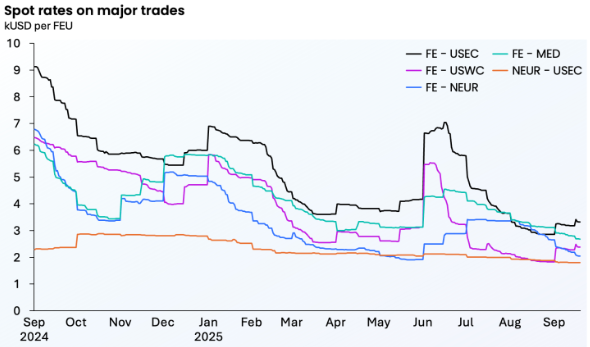
The Asia–Europe container trade is facing a freight rate drop. Spot rates have been falling almost every day as carriers compete hard for market share, even though demand is not strong enough to fill the extra capacity. Shipping lines are running large numbers of ships on these routes, creating oversupply and putting prices under pressure. Some carriers are even willing to operate below cost to keep their vessels full. (The Loadstar) (The Loadstar)
While the transpacific market has stabilised, the Asia–Europe route is still unstable, with rates driven more by pricing tactics than by real demand. (Nieuwsblad Transport)
Carriers are also avoiding long-term rate commitments. They prefer to wait until the market shows signs of recovery before offering contracts, but such a recovery does not appear likely in the near term. The start of October coincides with China’s Golden Week, normally a slow period, yet market volumes remain weak with no clear signs of improvement.

Air cargo demand grew slightly in the first half of 2025, but capacity increased even faster. This imbalance is making it harder for carriers to stabilise rates. At the same time, new U.S. import rules have reduced small parcel shipments, while flights from Asia are filling up quickly. The result is local overcapacity on some routes and lower spot rates overall, just as shippers are holding back ahead of the peak season.
What this means for air freight:
Rail freight between China and Europe is facing serious disruption due to Poland closing its border with Belarus, which forms a key transit route. The closure was triggered by military exercises in the area and drone activities around the Polish border, conditions that have sharply limited rail capacity. As a result, China’s ~€25 billion-per-year trade corridor to the EU is under strain, with delays and logistical obstacles increasing as freight traffic seeks alternative routes. (The Loadstar)
Shipping lines, through the World Shipping Council’s Cargo Safety Program, are increasingly deploying artificial intelligence to screen shipments with a strong focus on detecting undeclared or misdeclared dangerous goods. The AI tools use keyword searches, trade pattern recognition, and algorithms to flag high-risk cargo. Alerts are reviewed by carriers and, if necessary, verified through targeted physical inspections.
The Cargo Safety Program aims to prevent ship fires and protect crews, vessels, cargo, and the marine environment, according to the organisation. The recently published “Safety and Shipping Review 2025” by insurer Allianz shows that the number of ship fires has reached its highest level in ten years, with misdeclared cargo responsible for more than a quarter of all incidents. (The Loadstar) (Nieuwsblad Transport)


