The ACOT Q730 terminal in Antwerp will be closed on Monday, November 3 due to the All Saints Day holiday. Please be aware that this may cause delays in cargo handling.
Ocean freight spot rates on Asia-Europe and Asia-America routes rose slightly over the past two weeks. This is due to blank sailings and carriers applying General Rate Increases (GRIs) before annual contract talks. Some carriers may try additional rate hikes in the second half of November, but it is too early to tell if they will stick. (Nieuwsblad Transport)
Despite the recent uptick, the overall market balance remains weak. Demand continues to trail available vessel capacity, and analysts note that spot rates on key routes are still below pre-pandemic levels. The current improvements are therefore seen as stabilization attempts rather than signs of a sustained recovery. (The Loadstar)
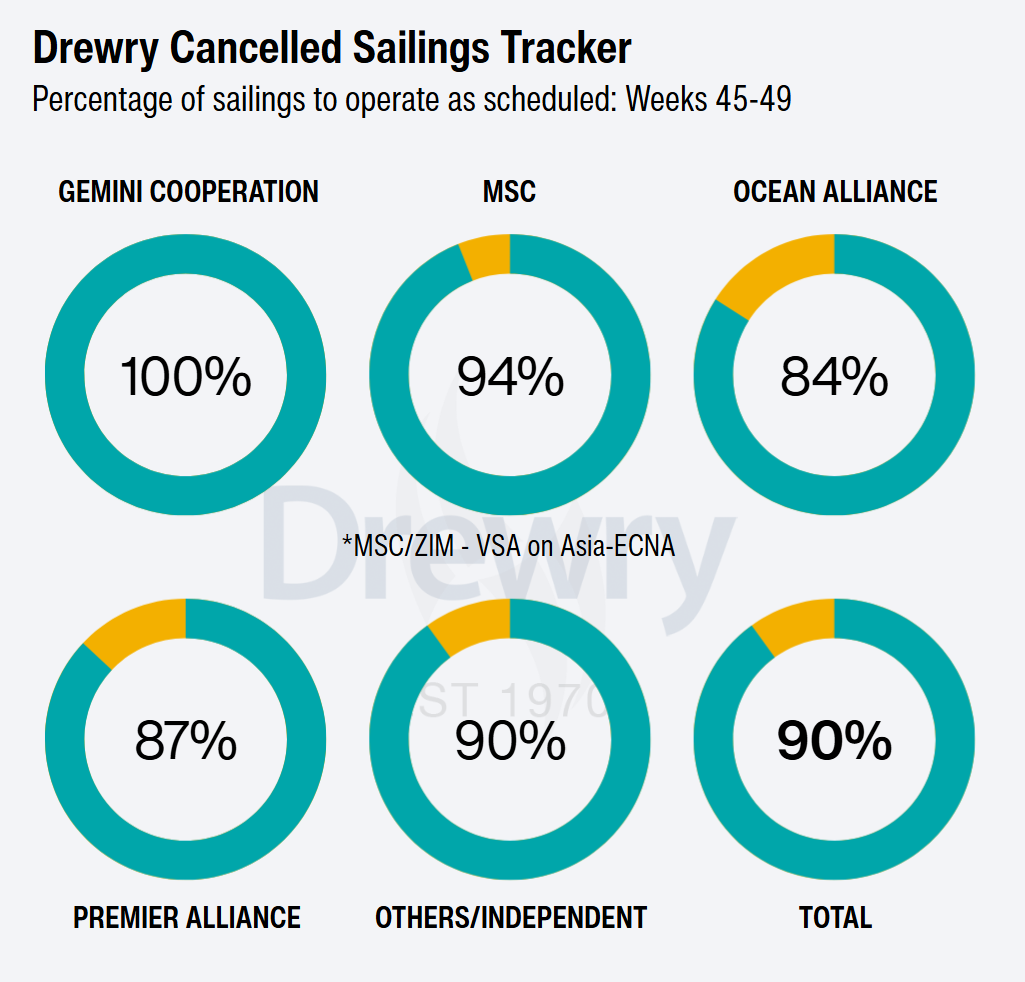
Blank sailings increased notably throughout October, reducing available capacity across Asia-Europe, Asia-America, and Europe-America routes, which has temporarily supported rates. There is still too much capacity in the market, which is expected to keep freight rates under pressure over the next few months.. (The Loadstar)

After months of volatility, global ocean freight markets are showing tentative signs of stability as carriers tighten capacity through blank sailings and cautious rate management
Rotterdam port congestion update
The Port of Rotterdam is slowly recovering from the October stevedore strikes. At the peak, 33 container ships waited to enter; this number has now dropped to about 13.
Storm Benjamin has temporarily slowed operations, causing longer waits and occasional crane stoppages. While the port is making progress, some congestion may continue in the coming weeks. (Nieuwsblad Transport)
China and the United States have agreed to pause the recently introduced port-call fees on each other’s vessels for 12 months. The move follows government talks aimed at easing tensions and keeping trade flows stable. The exact start date has not yet been confirmed, but the suspension reduces immediate cost pressure for carriers. (The Loadstar)
Before the suspension, some carriers had already changed services to avoid the fees. Several Chinese-operated sailings to the U.S. were blanked, and one vessel even skipped Chinese ports due to fee classifications. In the U.S., carriers faced high tariff charges, raising concerns about shifts in port operations. (The Loadstar)
While the agreement offers short-term relief, uncertainty remains. It is unclear if previously blanked sailings will return, and broader negotiations on tariffs and trade rules are ongoing. Shippers should expect continued adjustments to schedules and services in the coming weeks.
Airfreight rates have increased slightly on key trade lanes, particularly from Asia to Europe, following a temporary dip after Golden Week. However, the rise has not created a typical peak-season boost. (The Loadstar)
Market demand remains soft, mainly due to weaker e-commerce volumes and ongoing tariff uncertainty. Recent airline results confirm this trend, showing lower cargo revenues, reduced demand, and weaker load factors compared to last year. Capacity has grown more slowly than demand, keeping rates stable but not driving a strong rebound. (The Loadstar)
Some areas, like perishables and semiconductor components, are seeing modest growth, but overall expectations for the fourth quarter remain muted. No significant peak-season surcharges have been reported at this time, and the market outlook continues to be cautious. (The Loadstar)
The European road freight market is still grappling with a chronic shortage of drivers, estimating over 420,000 vacancies across the EU. This shortage is impacting availability, lead times, and reliability on key routes, particularly for importers relying on timely deliveries.
The situation is not improving anytime soon, and long-term solutions, such as recruiting drivers from outside the EU, will take time to implement. (The Loadstar)


