Welcome back.
The recent 3-day national strike in Belgium has severely impacted the Port of Antwerp-Bruges and inland connections.
After six weeks of continuous increases, spot rates on the Asia-Europe trade have dipped slightly this week. This shift is driven by a slight increase in capacity offered by carriers. Carriers are aiming to reverse this dip with new General Rate Increases (GRIs) effective from December 1st, hoping to build momentum during critical annual contract negotiations.
While indices suggest a potential uptick for next week, market experts are skeptical whether these increases will stick, expecting rates to settle slightly lower than the carriers' targets. In contrast, rates on the Asia-US trades saw sharper declines this week, driven by the Thanksgiving holiday lull and aggressive carrier discounting. (The Loadstar)
With Chinese New Year falling in February 2026, we anticipate a short peak in demand and rates throughout January. As vessel capacity remains tight, space will be tight during this period. We strongly recommend booking well in advance to secure allocation.
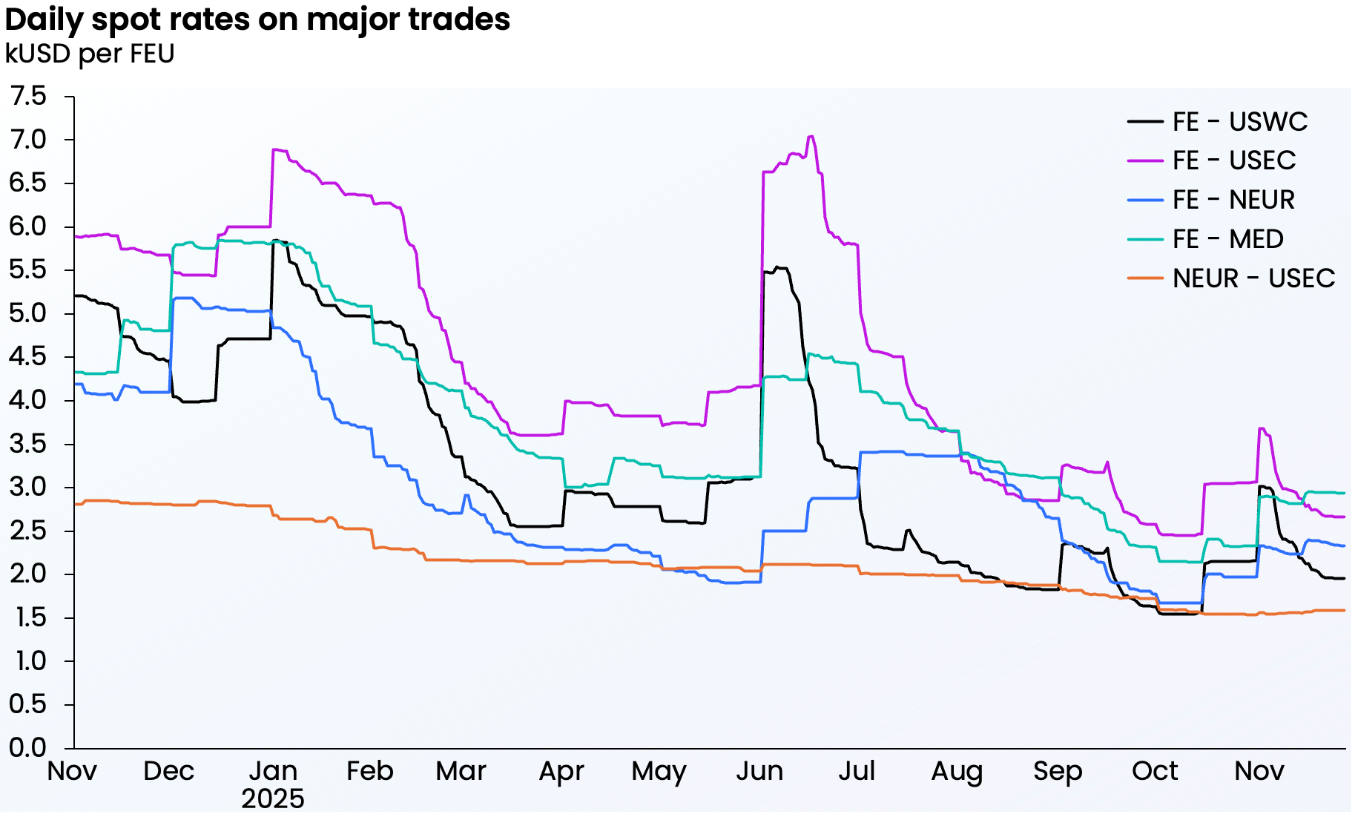
Despite recent reports suggesting a potential return of vessels to the Suez Canal, major carriers have reaffirmed that a full-scale return is not currently planned. While some carriers are cautiously testing the route with individual vessels or specific services (mainly eastbound towards Asia), the consensus remains that the security situation is still too fragile. A structural shift back to the Suez route is expected to be a matter of "quarters, not weeks." (Nieuwsblad Transport)
When the transition back to Suez eventually happens, experts warn it will not be without disruption. A rapid return could trigger a "vessel-bunching" effect, where ships routed via the Cape of Good Hope arrive simultaneously with ships returning via Suez. This would lead to severe port congestion across Europe.
The biggest bottleneck is expected to be on the land-side, rather than the quayside. If terminals become overwhelmed, the ability to move containers out of the port quickly will be key. Carriers indicate that a phased and coordinated return is the only viable option to minimize supply chain disruption. Analysts suggest that the most optimistic window for a safe and structured transition would be after Chinese New Year (February 2026), during the traditional slack season when volumes are lower. (The Loadstar)
Critical delays for road transport
The situation for road transport in Rotterdam has deteriorated significantly. Transporters are currently facing daily disruptions, resulting in waiting times of multiple hours at terminals and access routes.
The Knowledge Institute for Mobility Policy (KiM) forecasts a decline in total freight transport for the Netherlands in the coming years. Domestic transport is expected to shrink by 5%, while international transport could drop by nearly 9%.