Reefer capacity (refrigerated container space) is the biggest struggle across bookings. Carriers keep giving dry cargo priority, so reefer slots sell out first on the busy lanes.
On top of that, CMA CGM raised its rates again on its fast service through the Suez Canal, the route most reefer cargo from Asia uses. For perishable shippers that means less space and a higher price at once.
💡What to do for perishables shippers: Book reefer space early and share your forecasts with us, so we can hold space for you.
Space out of India is running out fast. Some carriers have stopped taking bookings until mid-August. Demand to North Europe is high and there are not enough ships to match it.
The monsoon makes it worse: heavy rain is slowing India's west-coast ports, and a fatal accident closed the terminal at Nhava Sheva (JNPA), India's biggest container port (The Loadstar).
💡 What this means: If you ship from India, book well ahead and ask your contact person about alternatives when your timing is tight.
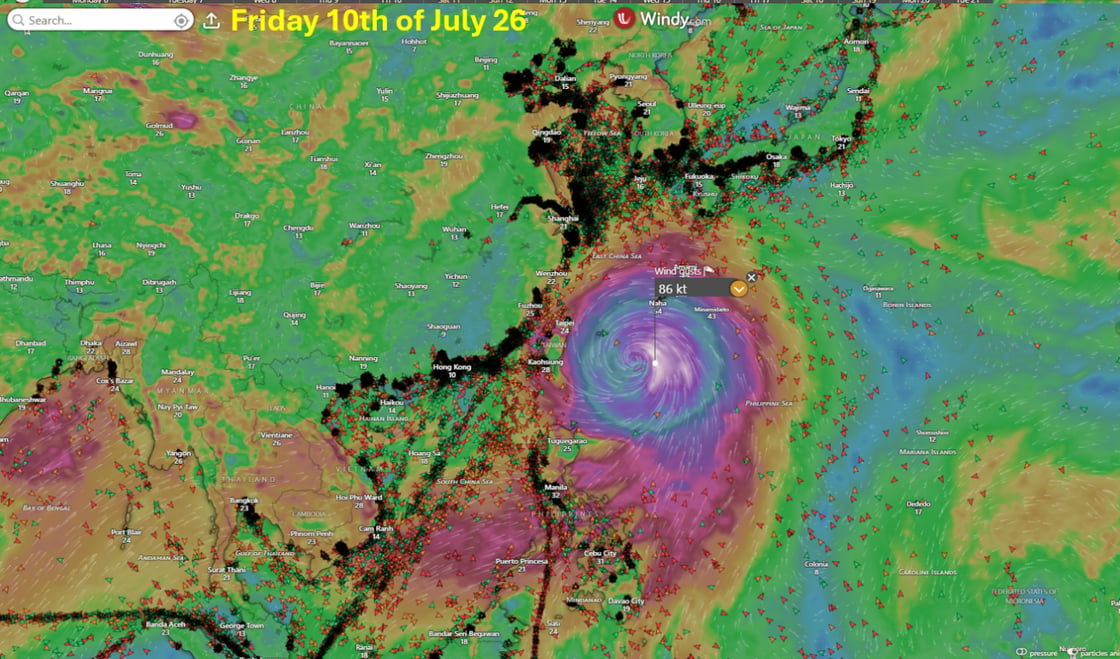
Typhoon Bavi hit Taiwan and the Fujian and Zhejiang coast overnight on 11 July. The following ports stopped operating from 10 July: Ningbo-Zhoushan, Shanghai Yangshan, Wenzhou, Fuzhou and Xiamen. Sailings will run 3 to 7 days late, and some were cancelled or merged. (Lloyd’s list)
💡What this means: If you have cargo on these lanes, add the delay to your planning.
Closer to home, the Rhine is exceptionally low for the time of year. Ships can load only about 30% of their normal capacity, and roughly 200,000 to 300,000 tonnes less cargo moves by barge each week (Nieuwsblad Transport). On 1 July the situation was raised to level 1, an impending water shortage.
Rotterdam's port rail is also near its limit, mainly around Botlek and Waalhaven. Expect tighter inland capacity and higher costs into the Netherlands and Germany.
💡What to do: Make sure to share your inland volumes with us early so we can plan around the bottlenecks.
Rates from Asia to North Europe are steady this week (Drewry World Container Index). We expect them to ease toward the end of July. The European peak is winding down, and carriers are cutting spot rates to fill their ships.
A peak season surcharge (PSS) is a temporary fee carriers add in busy periods, on top of the base rate and fuel. Read the full updated overview here.
🔁 What changed since our last update
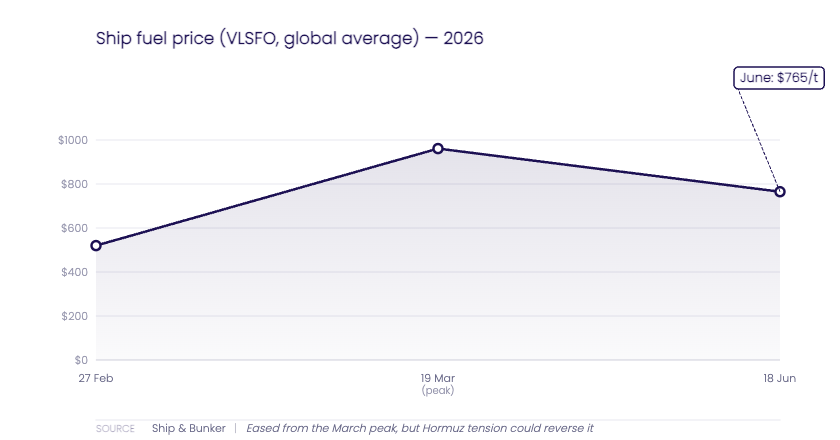
Ship fuel (bunker) got cheaper after a mid-June deal reopened the Strait of Hormuz, the channel that carries about a fifth of the world's oil. The benchmark price fell from about $960 per tonne in March to around $765 in June (Ship & Bunker). But it stayed fragile.
By early July, traffic was still about a third of normal, after some tankers turned back and President Trump called the peace deal over (CNN). Oil rose back above $80 a barrel.
💡 What this means: If tension flares again, bunker costs and surcharges can climb within weeks. We are keeping an eye on it and will inform you accordingly.
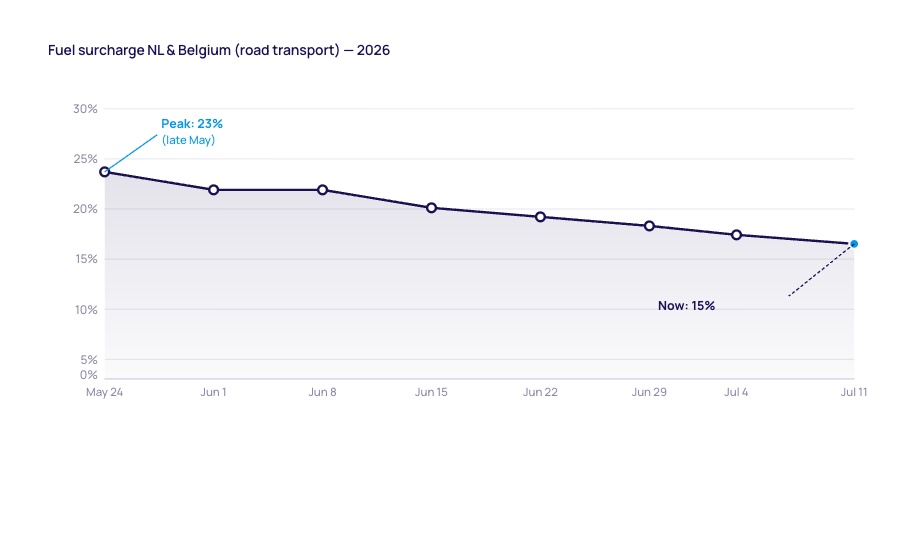
The road fuel surcharge for the Netherlands and Belgium fell to 15% this week (week 29), down from 23% in late May, as diesel eased to €1.87 per litre. However, in combin
What this means: The road fuel surcharge has decreased, but the new per-kilometre truck toll is now applied as a separate cost.
Maersk is moving a second service back through the Red Sea and Suez Canal, its India, Middle East and US East Coast route (Maersk). After more than a year of ships going around Africa, this points to slow normalisation. It will not happen overnight, and the Hormuz tension mentioned above could stall it.
💡 What this means: If this trend keeps going, transit times on these lanes should (very) slowly improve in the coming months. Keep a buffer for at least the coming months, as it will always take longer than expected to "return to normal", even if the Red Sea is fully open.
In early July, Costa Rica's National Emergency Commission held a Green Alert across the country. Heavy rain, saturated soils and landslides hit the road network. Trucking to and from port slowed, which delayed getting loaded containers to the port and empties back to shippers — with no alternative routes open at the time. We flagged possible delays to affected shippers then.
The situation has since eased.