This week in brief:
Shipping lines are sending container ships back through the Suez Canal. Linerlytica counted more than 45 large ships in the canal in two separate weeks, against fewer than 15 a week in early August.
What the carriers have announced
Carriers return to Suez service by service, not all at once. Each move depends on the security situation in the Red Sea, and carriers say they can divert again. This is the status on 19 October:
Not every source agrees. Reports differ on the exact services that have returned to the Suez Canal. We check the route per booking with the carrier, so confirm the date with us before you plan around it.
In the picture below you can see Shypple’s customers’ current shipments on vessels and their movements. Some vessels are moving towards the Suez Canal, but some have still chosen the Cape route.
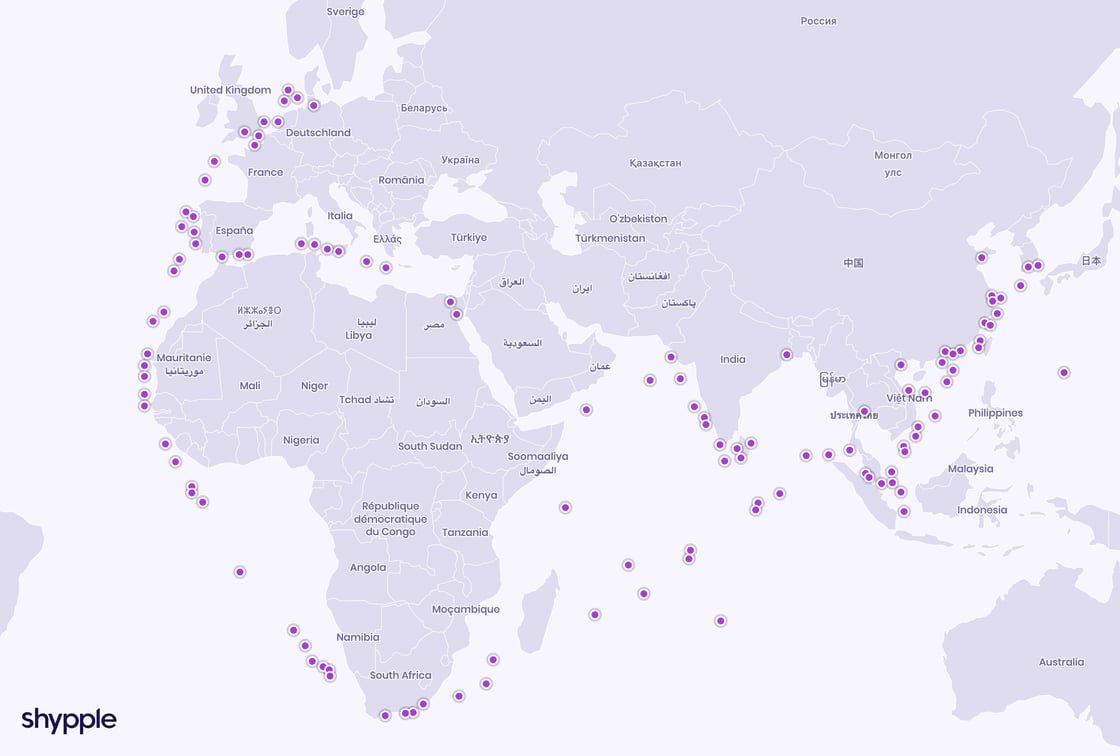
What this means for you: Not all ships switch at once. Services via Suez and via the Cape run side by side, so some ships arrive earlier than planned and others later. Marc van Haaren from our procurement team explains it in a short video. 👇

All schedules are now built around the Cape route, so they need time to settle. Some ships will arrive and leave in the same week, and that causes congestion at the bigger terminals. We and the shipping lines expect things to normalise after 3 to 6 months.
💡 What to do: Check the expected arrival date again before you plan warehouse space.
Rijkswaterstaat is closing parts of the A15 parallel carriageway towards Europoort and the Maasvlakte (the deep-sea container terminal area of the Port of Rotterdam) in stages, to replace asphalt. The A15 is the main road for trucks to the container terminals. Rijkswaterstaat expects up to 30 minutes extra at weekends and up to 60 minutes on weekdays.
Traffic towards the Maasvlakte has also used the hard shoulder of the old Suurhoffbrug since 16 September, and the ECT time slots at Delta and Euromax still apply.
💡 What to do: Avoid peak hours where you can. A late truck at ECT can mean a missed time slot, and the €100 surcharge for a missed slot still applies. Tell us early if a delivery is tight, and we look at timing together with the trucker.
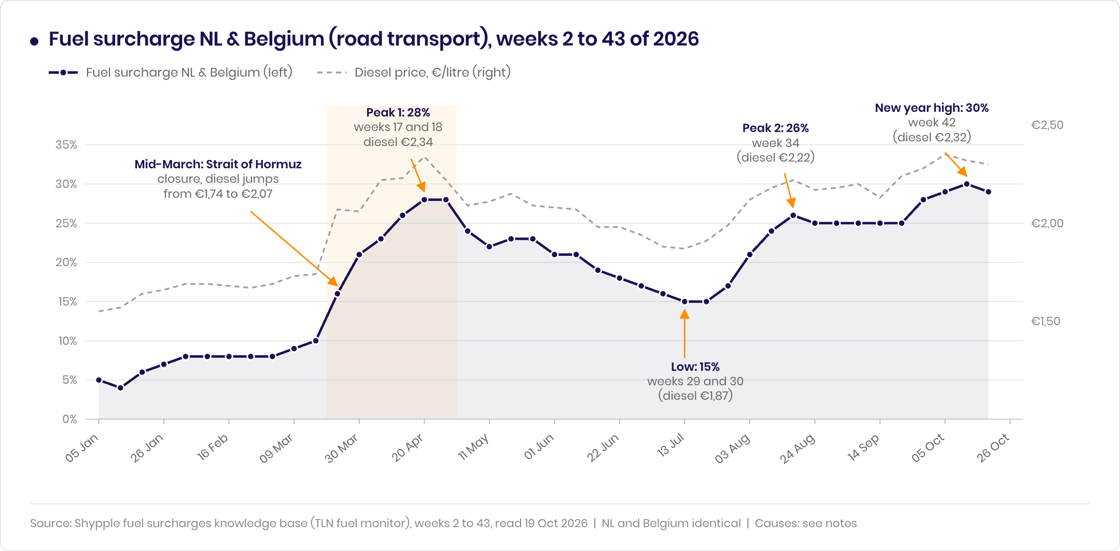
The road fuel surcharge for the Netherlands and Belgium is 29% in week 43 (19 to 25 October), down from 30% last week. Week 42 (12 to 18 October) was the highest level of 2026. Diesel averages €2,298 a litre, below last week (€2,323). The fuel surcharges knowledge base article already lists 28% for the week of 26 October to 2 November.
The chart shows what moved the price this year: the closure of the Strait of Hormuz in March, the first peak of 28% in April, a low of 15% in July, and the climb since August.
Spot rates from Asia to North Europe fell again in the week to 8 October, according to the Drewry World Container Index. Carriers have announced increases for the second half of October, but more space through Suez pushes the other way, Metro Global writes.
Our procurement team sees the same: most carriers are trying to push rates up, and the market takes it so far without much struggle, because there is still enough space. It is an early signal for the long-term contracts, as carriers start to aim higher.
Drewry counts 34 cancelled sailings on the big east-west trades between 12 October and 15 November, about 5% of all scheduled voyages. Half of them are on Asia to North Europe and the Mediterranean. One cancelled sailing can still hurt if your container is booked on it.
The Rhine's reference gauge at Kaub (the point that sets how deep barges can load) read 9 centimetres on the morning of 16 October. It rose to 20 centimetres on 13 October after rain and fell back since, according to Pegelonline (WSV), live gauge data. The German water authority BfG's 14-day forecast gives at least an 88% chance that the level stays below the long-term low-water reference of 77 centimetres through 28 October.
💡 What to do: If you move cargo by barge on the Rhine, talk to us about truck or rail alternatives for the coming weeks, and budget for higher inland cost.


