Ships out of India are taking almost no cargo for the second half of July. Carriers give a management decision as the reason, and warn that fixed prices may no longer hold. This is the same pattern we saw earlier from China.
Space is scarce for two reasons.
Nhava Sheva (JNPA, near Mumbai) is among the worst-hit ports worldwide, and Mundra has thousands of containers stranded with delayed freight trains. Our own agent in India reports the same picture.
This is already hitting fresh exports. Congestion at Mundra is delaying Nashik onion shipments to the Gulf and South-East Asia, which raises storage costs for shippers of perishable goods.
💡What this means: If you move cargo from India, book early and expect stacked surcharges and possible rerouting.
What changed since our last update (13 July)
CMA CGM raised its peak season surcharge (PSS, a temporary fee during busy periods) from the Indian subcontinent to Europe. It stepped up from $500 to $1,500 per container in a week. A separate charge applies to Red Sea ports.
For India, Pakistan, Sri Lanka → Europe & Med
Carriers now routinely cancel 10% to 14% of scheduled space through blank sailings. A blank sailing is a sailing a carrier drops, so booked space can disappear at short notice.
Analyst Sea-Intelligence, reviewed the first half of 2026. It calls this a permanent feature of how carriers run their networks, “rather than an occasional response to weak demand.” Blanked space has grown far faster than the fleet since 2019. On Asia to North Europe, blanked capacity is up 83% while the fleet grew 20%. For August specifically, space on Asia to North Europe tightens. Total capacity is down about 10% from late July, when it averaged 361,600 containers a week.
Carriers also protect their core east-west routes first. When they cut, they cut regional and feeder services before the main lanes.
Most carriers hold their schedules. The Ocean Alliance (Evergreen, OOCL, CMA CGM, COSCO) is the exception: it will blank a FAL1 sailing in week 34 and may cancel two more services in week 35, while CMA CGM shifts ships to the Mediterranean and trims North Europe space. Maersk and Hapag-Lloyd make only minor cuts and would rather lower rates than cancel voyages. MSC keeps fixed weekly rotations. THE Alliance plans no blanks.
💡 What this means:
Spot rates on the main east-west trades fell again last week.
Peak season has passed its high point on price, but the fall is slow because carriers keep capacity tight. India is the clear exception. See The Loadstar.
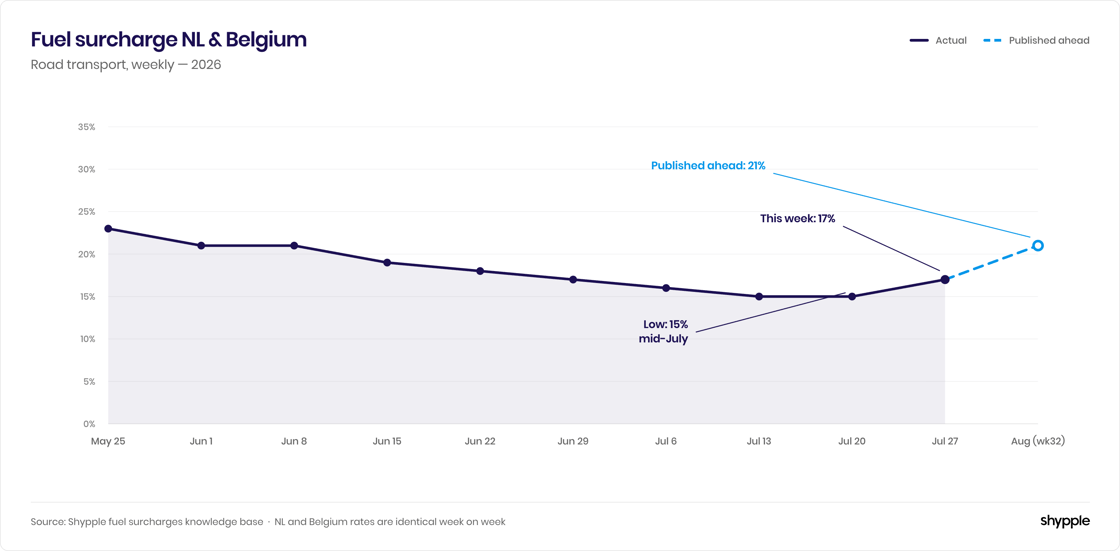
Road fuel surcharges bottomed at 15% in mid-July and are climbing again. This week is 17% for both the Netherlands and Belgium, and 21% is already published for the weeks ahead.
Low water on the Rhine has pushed CMA CGM and Hapag-Lloyd to add a low-water surcharge for German ports. It does not yet apply to Dutch destinations. We are watching it closely as summer water levels drop.
Closer to home, a train hit a truck at the Elbeweg in the Rotterdam port on Sunday and derailed onto it. No one was hurt. One rail track is out of service and one freight terminal cannot be reached by rail for now, with repairs not yet started.
💡 What this means: Two landside risks to watch. If you route through Germany or rail out of Rotterdam, build in a little extra time and ask us about alternatives.

Air cargo faces a tighter market. Spot rates are starting to cool, but fuel prices are rising, so carriers are caught in a balancing act. Demand for AI and tech hardware is propping up volumes, though analysts warn the peak may come early. Source: The Loadstar.
💡 What this means: If you ship by air, expect firm pricing and little give on contracts this quarter. Talk to us early to secure capacity.
Two changes are worth watching.
💡 What this means: Rules are shifting on several borders at once. Our customs team can check how these affect your shipments before they cause delays


