Operational alert: The ECT Euromax terminal will be fully closed from January 16 - 20 for a system migration, with a stop on empty returns starting January 12th. Because of this closure and recent bad weather, expect delays and limited capacity when the terminal reopens.
Winter weather leads to significant delays
Severe winter weather has significantly disrupted logistics across Northern and Western Europe over the past week. Snow, ice, and sub-zero temperatures are causing delays at terminals, depots, and throughout inland transport networks.
Last updates per (air)port:
Rotterdam: High impact. Reports indicated a standstill at the ECT Delta terminal operations due to safety concerns, with truck drivers advised to avoid the area. The status today (Monday, January 12th) is that everything is available again and apart from earlier caused delays everything is running as it should.
Hamburg: Faced significant slowdowns. While the CTA terminal has resumed operations, handling is considerably slower than usual. At the CTT terminal, rail and truck movements remain largely suspended, with waterside operations progressing slowly.
Bremerhaven & Wilhelmshaven: Experienced minor disruptions, though full shutdowns have been avoided so far.
Antwerp: In contrast, Antwerp reported no significant disruptions or shutdowns due to the weather.
Schiphol Airport (AMS): Winter weather also hit air cargo hard last week. Disrupted flight schedules and de-icing delays have created a backlog. While operations are recovering, expect delays in cargo handling and trucking connectivity
With the Chinese New Year (CNY) holidays beginning February 17, the traditional pre-holiday rush has shifted gears. We are seeing a fundamental change in how carriers are deploying capacity this year.
"Front-loading" strategy Unlike previous years, capacity on the Asia-North Europe trade is peaking early, projected to reach nearly 50% compared to 2015-2019, focusing on the 10-week period between Golden Week in early October and CNY. This is a deliberate move to "front-load" volumes, compensating for longer transit times (via the Cape) and ensuring European inventories are buffered well before the holiday shutdown. (The Loadstar)
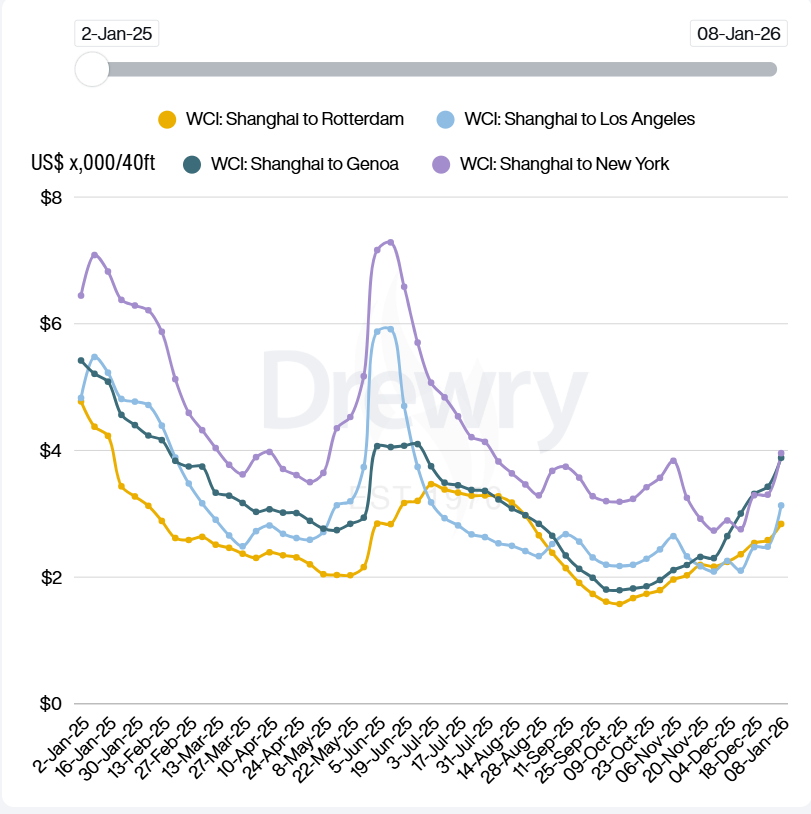
Rates & competition Demand is high and ships are full. Rates have gone up about 10-13% from Asia to Europe, but competition between carriers is keeping prices from skyrocketing. The actual market rates are currently lower than the steep increases carriers announced. (The Loadstar)
The risk for importers Everyone is shipping early to beat the longer transit times, which is clogging up the system. This increases the risk of delays at ports. Be warned: in the final two weeks before Chinese New Year, there is a high chance your cargo could get "rolled" (left behind) to a later ship. (The Loadstar)
Major rate increases on all tradelanes
2026 has kicked off with a jump in spot rates across all major trade lanes out of Asia.
We are seeing double-digit percentage increases on both Asia-Europe and Asia-America trades.
The usual Chinese New Year rush is colliding with the longer route around the Cape. Everyone is shipping early to avoid delays. Even though carriers are adding extra ships, every spot is being taken immediately. This keeps prices high, although competition is preventing extreme spikes. Once the pre-CNY dust settles, rates are expected to correct.
Rates dropped sharply in early January as the holiday rush ended. Airlines cut capacity by ~10% to match the lower demand. However, rates from Taiwan remain high because demand for high-tech goods is still strong.
Congestion warning with shipments via Bangkok, where e-commerce surges are causing delays of 3-7 days. Major hubs like Hong Kong, Taipei, Singapore, and Tokyo also remain congested. We expect the market (and rates) to tighten again later this month as Chinese New Year approaches.(The Loadstar)
Blank sailings: 7% cancellation rate
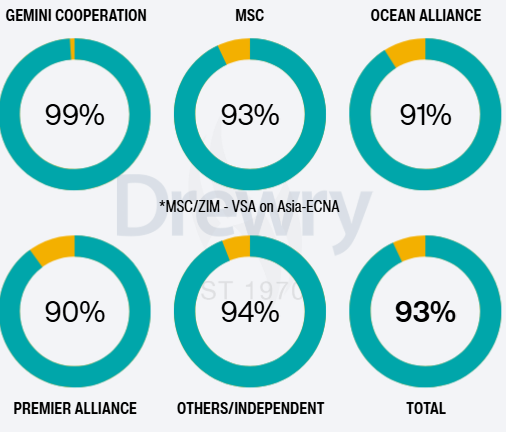
In the run-up to the Lunar New Year on 17 February, carriers have adjusted capacity to capture pre-holiday demand. From 12-18 January to 9–15 February, 7% of sailings have been withdrawn (48 of 701 sailings).
Most cancellations are concentrated on:
Asia-America routes (40%, was 38%) ,
followed by Europe-America (40%, was 45%)
and finally Asia-Europe/Med (20%, was 17%).
Yellow represents the percentage of cancelled sailings per carrier alliance. (Drewry)
Suez Canal update: A "stepwise" return?
There is a faint glimmer of activity in the Suez Canal, as Maersk successfully sent a vessel through and waived the 'transit disruption fee' for this specific trip (India/Middle East-US east coast MECL1 route). However, don't count on a full return just yet.
Maersk describes this as a "stepwise approach" and emphasizes that safety remains the absolute priority. This appears to be an isolated test run. Subsequent vessels on the same service have already routed back around the Cape of Good Hope. While this is a significant step, they emphasized that a wider network shift back to the trans-Suez corridor is not currently planned. Safety remains the absolute priority. (The Loadstar)
Top reads from last week:
Freighters grounded at Schiphol as airport 'fails to cope' with snow
Bribery allegations threaten DP World's expansion plans in India
Ocean & Air
Global
General cargo
Team Shypple
Get market updates delivered
Subscribe to our bi-weekly insights on freight rates, market trends and logistics developments
Thank you! Your submission has been received!
Oops! Something went wrong while submitting the form.