War risk surcharges, stabilizing ocean rates & surging trucking costs
Team Shypple
April 7, 2026
Welcome back.
The rise of unregulated "war risk" surcharges
Due to the ongoing conflict in the Middle East, ocean carriers are introducing new "War Risk" surcharges for shipments routed through the region.
Why they are introduced: Carriers are implementing these surcharges to cover the escalating costs associated with navigating high-risk areas. This primarily includes significantly higher maritime insurance premiums and the costs of additional security measures.
Pricing and transparency: Unlike standard fuel surcharges, these war risk surcharges currently lack a standardized formula or clear benchmark. As a result, the exact link between the surcharge amount and the actual underlying costs remains difficult to verify for the market.
What is happening in the market:
The layering effect: The market is dealing with multiple fees. Shippers are faced with fuel surcharges (EFS) and war-risk surcharges simultaneously, raising concerns that the exact same regional disruption is being priced multiple times.
A dangerous precedent: The industry fears that this behavior reflects market power rather than actual cost movements. There is a growing concern that carriers are simply monetizing global supply chain shocks, and that these unilateral pricing mechanisms could become permanently embedded even after the disruptions fade. (The Loadstar)
What this means for your shipments: This lack of regulation leaves cargo interests highly exposed to independent pricing decisions. At Shypple, we are heavily inspecting this surcharge environment and will continue to push carriers for strict transparency. (The Loadstar)
Ocean rates: Rates stabilize despite surcharges
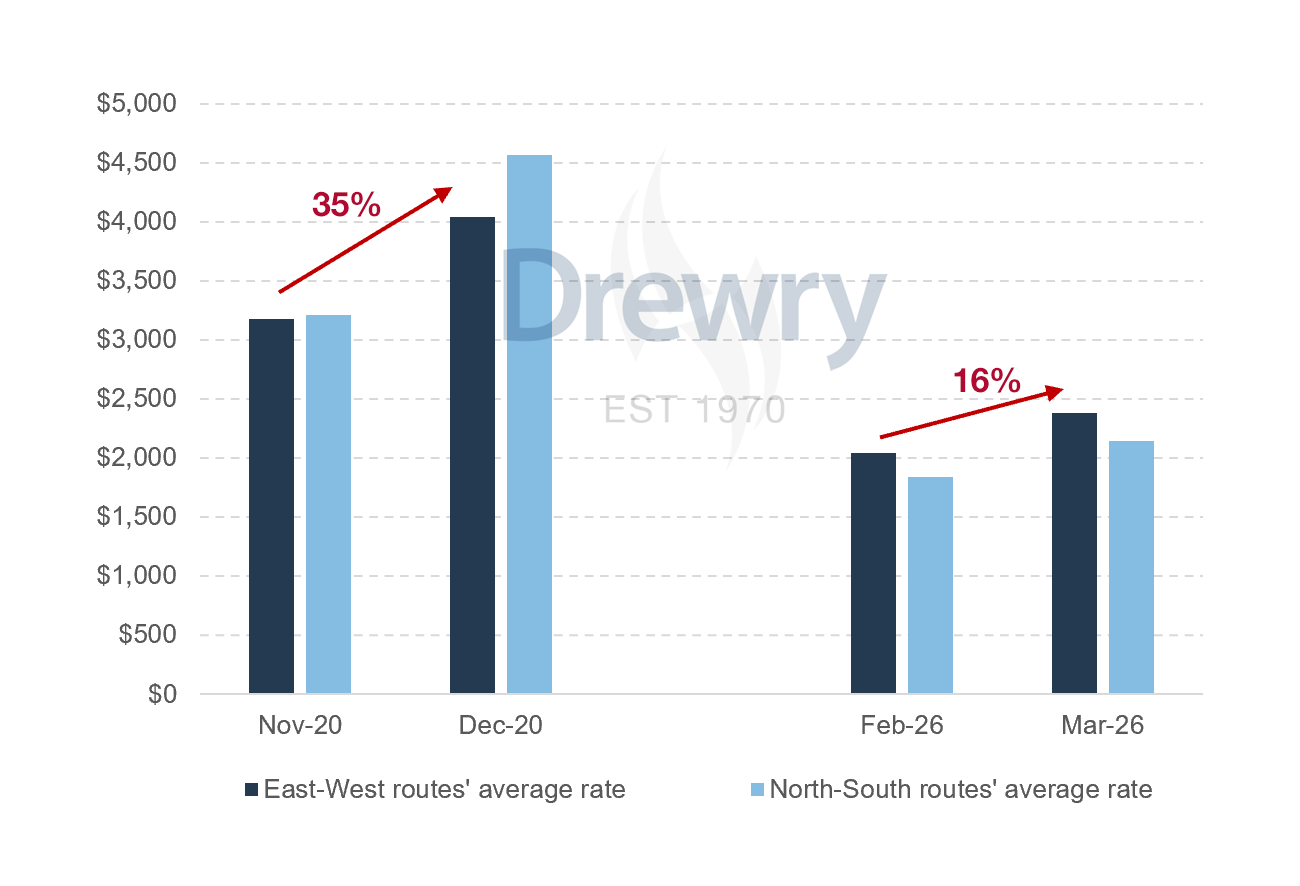
Despite the severe disruptions in the Middle East and the implementation of heavy surcharges, the anticipated explosion in global ocean freight rates has not happened yet. While regional trades to the Gulf face extreme spikes, the broader Asia- Europe routes are currently showing resilience.
No COVID-19 repeat: Analysts confirm that the global impact on container rates is significantly smaller than during the pandemic. Global vessel capacity remains largely intact, which prevents runaway rate hikes as long as overall demand remains moderate.
Slight downward trend: The demand for space is currently limited. Accordingly, carriers are struggling to continue their announced General Rate Increases (GRI). Instead, they are prioritizing volume over profit, causing base rates to slowly trend downwards.
Ultra-short-term pricing: To protect themselves against extreme fuel volatility and fluctuating demand, carriers have adopted an "ultra-short-term approach." We currently see carriers issuing spot rates with only a 7-day validity window.
The fuel wildcard: While base ocean freight rates are stabilizing or slightly dropping, skyrocketing bunker fuel costs remain the elephant in the room. Carriers are actively using Emergency Fuel Surcharges (EFS) rather than base rate hikes to compensate for their operational losses. (The Loadstar)
India & Middle East routing: port waivers and alternative routes
Indian ports are offering financial relief for stranded cargo, while ocean carriers are building new routes to bypass the Hormuz Strait.
Port fee waivers: Major Indian ports (like Mundra and Nhava Sheva) are helping exporters by offering a 15-day storage fee waiver, dropping terminal handling fees, and giving up to an 80% discount on reefer plug-in charges for stranded Gulf-bound containers.
Alternative routing: Carriers are slowly reopening bookings to the Middle East by unloading at alternative ports outside the danger zone, such as Sohar, Salalah (Oman), Khor Fakkan (UAE), and Jeddah.
Trucking shortages: To get the cargo from these alternative ports to its final destination, carriers use cross-border trucking. However, local truck capacity is currently severely limited and unstable.
High rates & scarce reefers: Freight rates to the Middle East have spiked (reaching up to $4,000 per 40ft from India). Meanwhile, reefer space is extremely hard to book, as carriers are prioritizing standard dry containers to reduce transit risks. (The Loadstar)
Trucking: Surging fuel costs for road transport
European road freight operators are facing mounting financial strain. A combination of surging fuel prices linked to the Middle East conflict and upcoming regulatory changes is intensifying pressure on an already fragile transport market.
What is happening on the road:
A structural shift in fuel costs: The International Road Transport Union (IRU) warns that current diesel price hikes are not a short-term fluctuation, but a structural shift. With fuel representing up to 30% of operating costs, this energy crisis is creating immediate financial pressure and volatility across the European trucking ecosystem.
Underlying market fragility: The sector was already grappling with persistent driver shortages, uneven volume recovery, and inflation squeezing consumer demand. These compounding factors leave transport companies with very little margin to absorb new shocks. (The Loadstar)
Blank sailings: 7% cancellation rate
From 6 April to 10 May, 7% of sailings have been withdrawn (46 of 705 sailings).
The market appears to be stabilising within a narrow range, with cost pressures persisting but limited momentum for significant rate escalation.
Most cancellations are concentrated on:
Asia-Europe/Med (43%, was 28%),
followed by Asia-America routes (41%, was 58%),
and finally Europe-America (16%, was 14%).
Yellow represents the percentage of cancelled sailings per carrier alliance. (Drewry)